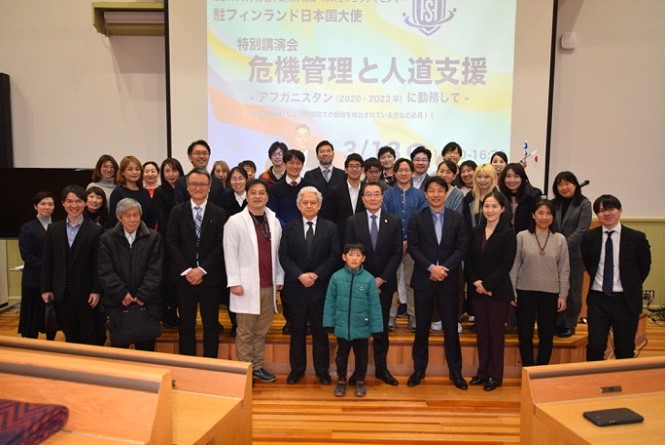
Report of the Special Lecture by Ambassador Takashi Okada, Ambassador Extraordinary and Plenipotentiary of Japan to Finland
On March 13, the Center for Health Security of the Kyoto University Graduate School of Medicine hosted a special lecture by Ambassador Takashi Okada, Ambassador Extraordinary and Plenipotentiary of Japan to Finland. Under the title “Crisis Management and Humanitarian Assistance,” Ambassador Okada looked back on the three years in which, as Ambassador of Japan to Afghanistan, he confronted a succession of extraordinary challenges, including the Taliban’s takeover, the evacuation of personnel and other concerned individuals, the reopening of the Embassy, and engagement with the Taliban. Drawing on these experiences, he spoke about judgment and practice on the front line of crisis.
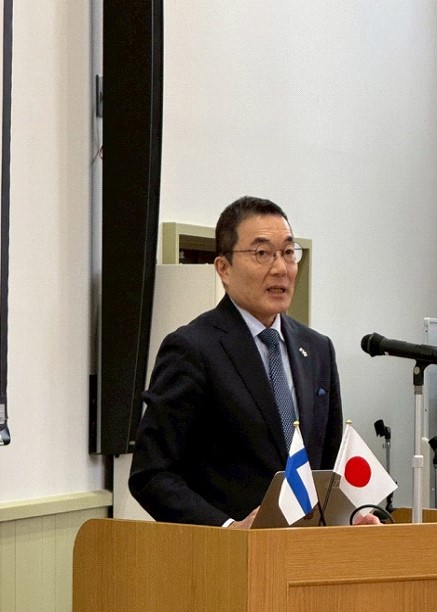
In the lecture, Ambassador Okada emphasized three important points in crisis management. First, it is essential to grasp rapidly changing situations accurately, think through a broad range of possible scenarios, and repeatedly conduct exercises to confirm preparedness. Second, when decisions must be made under limited information, one must return each time to the underlying purpose and think calmly. Third, relationships of cooperation that function in emergencies cannot be built overnight; networks must be cultivated in ordinary times. Through his firsthand experience, he conveyed that decision-making in the midst of crisis depends not only on quick judgment in the moment, but also on the preparedness and trust that have been built day by day.
Ambassador Okada also spoke candidly about humanitarian assistance. The reality, he noted, can be extremely harsh, and at times it can feel as though one is “Plowing the sands.” Even so, humanitarian assistance is not merely a temporary response to the suffering immediately before us; it is also the work of quietly remaining beside people, trusting in the hope and resilience that continue to live within local communities. He further explained that its ultimate aim is people’s self-reliance, and that support must extend seamlessly from livelihood recovery to development assistance. Even when results are not immediately visible, he stressed the importance of believing in people’s dignity and capacity to endure, and of continuing to engage patiently even with authorities whose ways of thinking differ greatly, grounding these reflections in the realities on the ground.
The lecture provided a valuable opportunity for participants to deepen their understanding of the perspectives and mindset required in the fields of crisis management and humanitarian assistance.