Report of the KUSPH International Lecture: Redefining Sudden Death by Postmortem Investigation
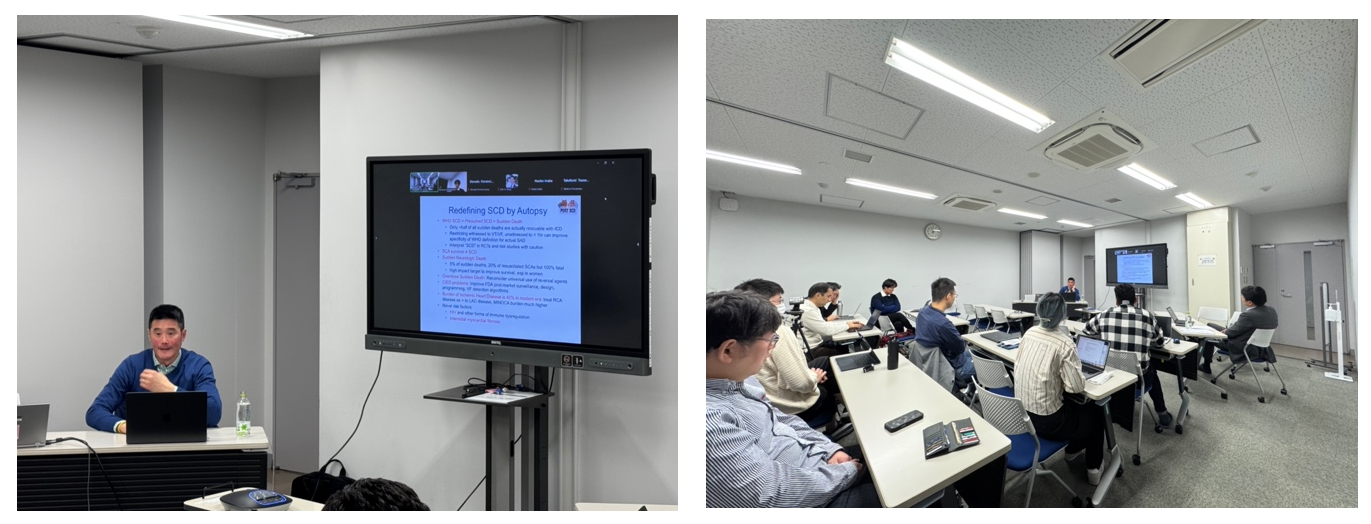
On December 16th, 2025, an international lecture titled “Redefining Sudden Death by Postmortem Investigation” was held at the School of Public Health, Graduate School of Medicine, Kyoto University (KUSPH).
About 15 students and faculty members from KUSPH participated in this international lecture, which was held as a hybrid (on-site and via Zoom). Prof. Zian H. Tseng, Professor of Medicine in Residence, Murray Davis Endowed Professor, Cardiac Electrophysiology Section, Cardiology Division, University of California, San Francisco, was invited as a guest speaker. The purpose of the lecture was to present the latest findings from the UCSF POST SCD (Postmortem Systematic Investigation of Sudden Cardiac Death) study.
Sudden cardiac death (SCD) remains a major public health challenge; however, much of the existing research on its causes has relied on death certificate data, which may be subject to substantial bias. In particular, the long-held belief that approximately 80% of SCD is attributable to ischemic heart disease is thought to be strongly influenced by selection bias resulting from low autopsy rates.
The UCSF POST SCD study, led by Professor Tseng, was designed as a prospective, systematic, autopsy-based investigation of an entire community. Since 2011, the study has comprehensively captured sudden deaths occurring outside hospitals and in emergency departments in San Francisco. By achieving an exceptionally high autopsy rate of approximately 97% for WHO-defined SCD, the study has minimized the selection bias that has limited previous research.
The findings revealed that among autopsy-confirmed sudden deaths, sudden arrhythmic death accounted for only about 56% of cases, while approximately 40% were due to non-cardiac causes, including drug overdose, neurologic disorders, hemorrhage, and pulmonary embolism. These results indicate that a substantial proportion of sudden deaths are not amenable to rescue by automated external defibrillators (AEDs) or implantable cardioverter-defibrillators (ICDs). In contrast, among patients who survived sudden cardiac arrest, approximately 98% of cases were attributable to cardiac causes, demonstrating a markedly different etiologic profile from fatal SCD. This discrepancy highlights the potential risks of directly extrapolating findings from sudden cardiac arrest research to strategies for preventing sudden cardiac death.
In closing, Professor Tseng emphasized that the POST SCD study redefines both the concept and etiologic structure of sudden death, underscoring the need for a comprehensive perspective that extends beyond the traditional arrhythmia-centered model. He concluded that integrated intervention strategies addressing non-cardiac causes—such as neurologic sudden death and drug overdose—represent critical targets for near-term prevention of sudden death.
In addition, Professor Tseng is currently advancing research aimed at the prevention of cardiac arrest through molecular biological approaches, including transcriptomic and proteomic analyses, using tissue specimens and biological samples collected in the POST SCD study. Such a comprehensive approach that integrates molecular-level analyses into sudden cardiac death research remains extremely rare worldwide. In the future, it will be important to apply the perspectives and methodologies of the POST SCD study to Japan’s world-class cardiac arrest registries, such as the nationwide Utstein registry and the Osaka CRITICAL study. This lecture was therefore highly informative and provided valuable insights into the future development of cardiac arrest and resuscitation research.