Report: Dementia Risk and Consequences Across the Life Course: Evidence from Swedish Nationwide Register-Based Studies —Linking Life-Course Characteristics to Dementia Risk and Outcomes: From Adolescence to Old Age
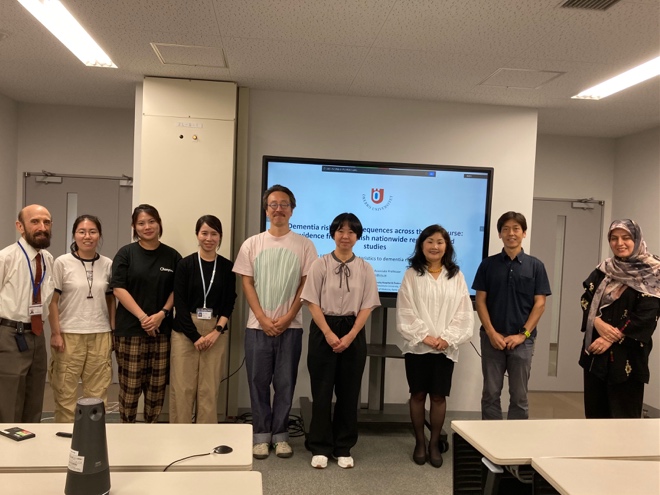
In the afternoon of October 7, 2025, an international lecture titled ” Risk and Consequences Across the Life Course: Evidence from Swedish Nationwide Register-Based Studies -Linking Life-Course Characteristics to Dementia Risk and Outcomes: From Adolescence to Old Age” was held at the School of Public Health, Graduate School of Medicine, Kyoto University (KUSPH).
About 20 students and faculty members from KUSPH participated in this international lecture, which was held as hybrid (on-site and via Zoom). Dr. Ayako Hiyoshi, Associate Professor and Epidemiologist, Örebro University Hospital and Örebro University, Sweden, was invited as a guest speaker. The aim of the lecture was to introduce dementia risk and outcome in Sweden from life-course perspective.
After introducing her background, Dr. Hiyoshi provided an overview of the motivation and background of the study on dementia risk and consequences. She described the DARE database she constructed, which links over 30+ Swedish national, regional, and disease-specific registers, covering everyone who lived in Sweden since 1968 to 2023, to (re)assess dementia risk and consequences. She then introduced two studies from the project.
The first study examined whether hearing impairment may have a causal role in dementia risk. Based on the longitudinal cohort study, her research team revealed that hearing impairment of Swedish men during their late adolescence, typically around age 18, appeared to be associated with increased risk of dementia by age 72. However, the effect sizes were modest (population attributable fraction approx. 3%).
The second study explored the difference in the use of social care services by immigration status. The research team hypothesized that, compared to native-born Swedes, dementia patients who were born in abroad may have longer duration between the time of dementia diagnosis and the initiation of home-based social services may due to lower access to relevant information. As a result, the probability of hospitalization may be higher due to insufficient service provision resulting in unmet needs for selfcare and other aspects important for maintain optimal health. Preliminary results suggested such trends. Further analysis, including stratification by country of origin and calculation of the estimated duration of each state, is currently in progress.
Finally, Dr. Hiyoshi concluded that her research team aim to contribute to the prevention and delay of dementia progression. Similarly, they aim to provide useful information to guide resource allocation for social services and promote equality of care, as ultimately, everyone dies, and many require social services before death.
After the lecture, she described characteristics of Swedish data and general possibilities and limitations, followed by a question-and-answer session on studies and Sweden’s healthcare and social service systems.